

Quantum Computing for Fun and Profit
How can I maximize my payout when playing Plinko?

This publication is by members of the Algorythm Community. A network of 20k+ black software engineers sharing technical insights across all fields of software development. Join us on LinkedIn, Facebook and Subscribe for more insights.
My current interests are many things involving quantum information, as I work on quantum-safe cryptography. For this article, I’d like to present a classical problem that was asked by a trader when I participated in a PhD symposium hosted by a prop trading firm on Wall Street many years ago. It stuck with me because of the elegance of its solution.
Today, finance departments in quantitative research are still fascinated by derivations of this problem.
Last summer (2025), I worked with two researchers, Otene Sunday ThankGod and Jibril Abdullahi, on an efficient quantum implementation as a Womanium & Wiser Quantum Program Scholar. The Goal: “How can I maximize my payout when playing Plinko?”
Plinko is essentially the Galton-Box Problem

It’s time to play “The Price is Right!” But what does this have to do with Quantum Computing?
Let’s say you were chosen as a contestant on “The Price is Right” and have a chance to win a big payout by playing the game “Plinko”. Plinko is a game in which a contestant stands at the top of the stairs looking down at a board with varying levels of cash prizes.
The goal as a contestant is to drop the ball from a starting position to maximize your payout (we want to end up in the slot with the most cash value).
Modelling a Game with Maths
Statisticians have been fascinated with this problem because we can model the problem as a statistical likelihood problem with some degree of uncertainty. Additionally, it’s a great example to visualize the Central Limit Theorem as we find our solution converges to Binomial Distribution. Solutions that demonstrate this often contain some sort of Monte Carlo simulation.
Many papers and blog posts have been written about the Galton-Box or Galton Board problem, where our Galton-Box is our Plinko board and we have a series of pegs laid out with a depth for our box, n. For this post, we can ignore the term and its definition, so every time “Galton-Box” is mentioned, replace it with “Plinko board”. Galton himself is a problematic contributor to the field of statistics, but I digress, because our focus is Winner winner chicken dinner!
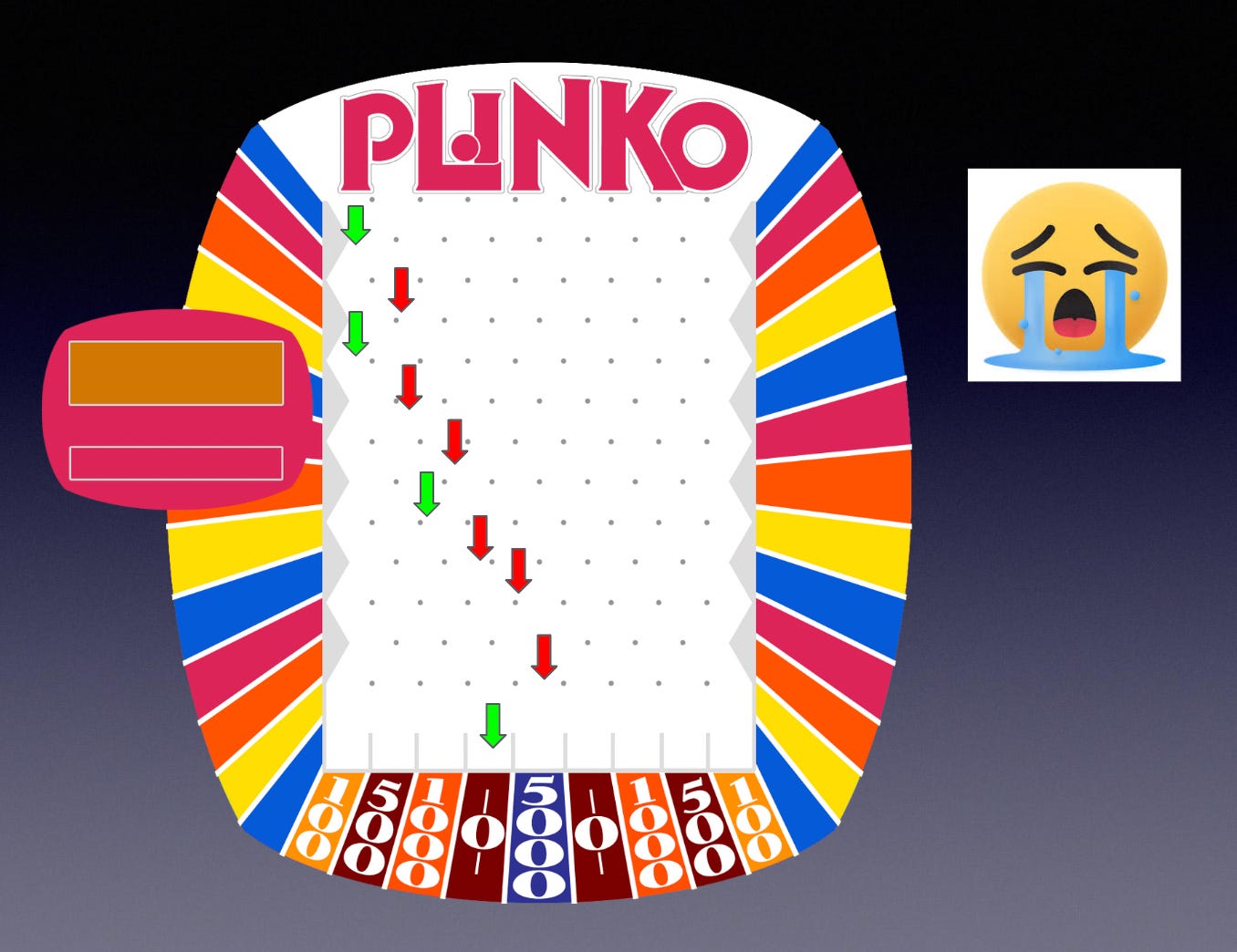
So what are the odds that if I stand at the extreme left side of the board, my ball will land at the top cash prize by the time it makes its way to the bottom of the board? We can imagine ourselves standing at the top of the stairs, dropping the ball and calculating for each peg on the board what the probability of the ball going down a certain path might be. As we try each starting position, we note which are more successful than others, but doing this over and over for each iteration is tiring!
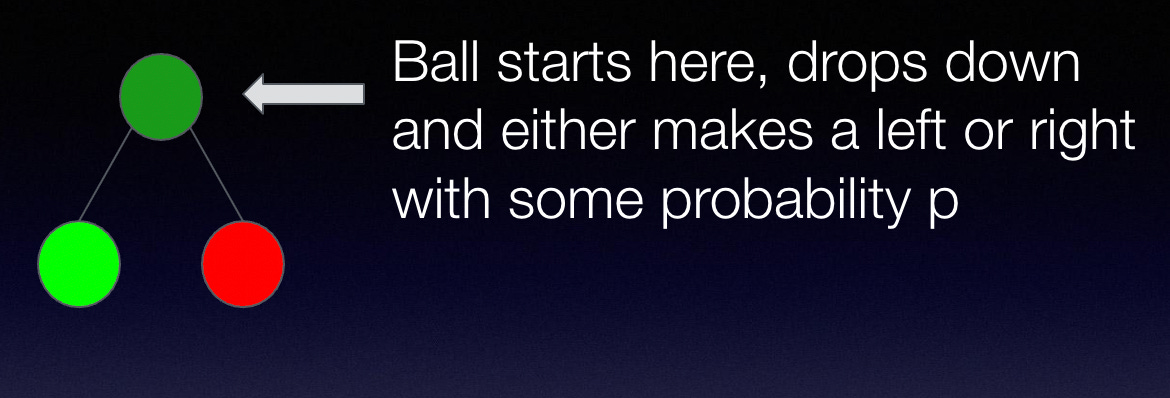
Marked Trees and Random Walks
If you noticed that each path resembles a tree, you would be right, as our path is essentially a discrete random walk with a number of steps over a time t, where with some probability the ball drops left or right as it hits a peg.
In traditional computing, when we want to solve a problem that may have many solutions, we might use backtracking to traverse every possible solution. Think about using a classical computer to solve Sudoku or the N-Queens Problem.
How would we solve this Quantumly?
In Quantum Computing, we can use Quantum Walks, a type of Quantum Algorithm (that is the quantum version of a classical random walk) to find paths that are “marked”, meaning that they will lead to some solution (this solution may be wrong or correct, but this is distinct from a partial solution where we are not certain whether one exists after running the algorithm).
We can then use a subroutine of this algorithm, called a Quantum Fourier Transform (QFT), to make our solution “faster” by using some sort of evolution operator. QFTs are the cornerstone of many of our current Quantum algorithms such as Shor’s Algorithm, which was developed in 1994 to find prime factors of an integer.
What do you Mean by Faster?
Since QFTs use superposition (meaning that they can traverse a number of possibilities simultaneously), a concept intrinsic to quantum mechanics, they can provide what we call a “quantum advantage”; a speedup in the land of quantum solutions relative to a classical solution (where a classical solution means a world where we do not have access to a quantum computer).
TLDR
As it turns out, Plinko is a real-world abstraction for the (Quantum) Galton-Box problem. With a quantum solution, we would model each peg as a “quantum peg”, which is composed of a number of quantum gates which we need to set, swap and reset for each round.
However, one of the challenges of implementation for finding a solution that may provide a quantum advantage is that our current quantum computers are noisy and therefore error-prone, meaning that finding a solution as we increase the depth of n becomes challenging.
Perhaps in the future, as quantum computers become fault-tolerant (meaning that they are less error-prone), these problems and their implementations will become more tractable. Bonus: Statistically, the middle slot is the best spot to maximize a payout.
About The Author

Krystal Maughan is a PhD student currently working on Quantum-Safe Cryptography.
More reading:
Binomial Distribution: https://en.wikipedia.org/wiki/Binomial_distribution
The Central Limit Theorem: https://en.wikipedia.org/wiki/Central_limit_theorem
“The Skeptical Statistician: Games of the Price is Right: Plinko”, https://theskepticalstatistician.blogspot.com/2012/09/games-of-price-is-right-plinko.html
Marked Vertices: “Quadratic speedup for finding marked vertices by quantum walks”, https://arxiv.org/pdf/1903.07493
Monte Carlo Simulation: https://en.wikipedia.org/wiki/Monte_Carlo_method
N-Queens Problem: https://en.wikipedia.org/wiki/Eight_queens_puzzle
Sir Francis Galton: https://en.wikipedia.org/wiki/Francis_Galton
Quantum Walks, Notes by Andrew Childs on Quantum Algorithms: https://www.cs.umd.edu/~amchilds/qa/qa.pdf
Quantum Galton Box: “Universal Statistical Simulator”, “Universal Statistical Simulator” Carney M., and Varcoe B., 2022, https://arxiv.org/abs/2202.01735
Quantum Fourier Transform, https://en.wikipedia.org/wiki/Quantum_Fourier_transform
Quantum Walk: https://en.wikipedia.org/wiki/Quantum_walk
Random Walks: https://en.wikipedia.org/wiki/Random_walk
Shor’s Algorithm: https://en.wikipedia.org/wiki/Shor’s_algorithm
Quantum superposition: https://en.wikipedia.org/wiki/Quantum_superposition
Time Evolution Operators: https://en.wikipedia.org/wiki/Hamiltonian_(quantum_mechanics)#Schr%C3%B6dinger_equation
I cannot help but think of the security implications and vulnerabilities that quantum computing presents. Great practical walk through of the maths!